


Key Takeaways
- The main difference is the toe spike. Baseball cleats usually have one, but soccer cleats do not.
- Soccer boots are designed for quick changes in direction and better ball control. Baseball cleats are made for running straight and gripping the ground.
- In football, referees may not let you play if your shoes are seen as dangerous.
- For kids, the rules are often stricter, especially when it comes to metal spikes and toe cleats.
- Too much traction can be risky. Studies show that higher rotational traction is linked to about 2.5 times higher odds of injury in pooled data.
Table of Contents
Difference Between Soccer And Baseball Cleats
Soccer cleats help you move quickly and safely in any direction. Baseball cleats are made for fast starts and strong grip on dirt or grass.
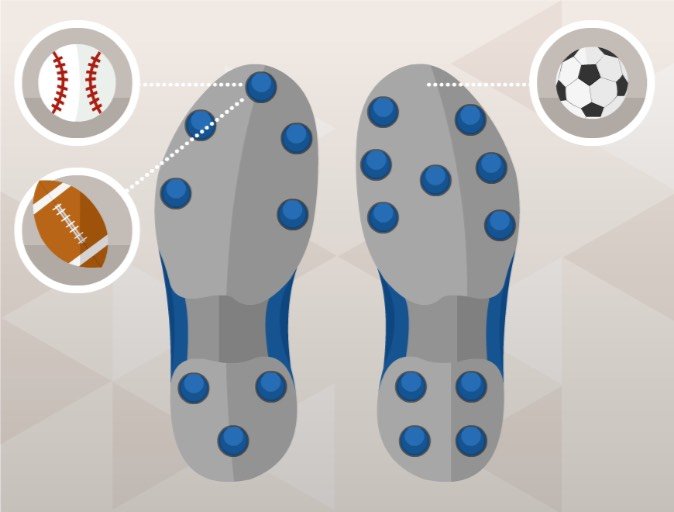
One big design difference is the front toe cleat, also called a toe spike. Many baseball cleats have an extra stud at the toe for quick starts and digging in, but soccer cleats usually do not have this feature.
They also feel different on your feet. Soccer cleats are light, close to the ground, and let you move easily because you are always running, turning, and handling the ball. Baseball cleats feel more solid and supportive, with extra cushioning, since the game has quick bursts and stops instead of steady running.
This matters because you should not swap one type of cleat for the other in real football games. Even if you can run in them, you still need to think about:
- Safety (toe spikes + contact situations)
- Rules (referee inspection and “dangerous equipment”)
- Performance (traction that either slips too much, or “grabs” too much)
Key Design And Performance Differences Between Baseball And Soccer Cleats
Soccer and baseball players move in different ways, so their shoes are made to match those movements.
In soccer, players are always changing direction with quick starts, stops, cuts, and turns. Soccer shoes need to grip the ground in every direction and fit tightly so you can feel the ball better.
Baseball uses different movements. Players still sprint, but they mostly run straight, stop quickly, and need a strong grip for batting and running the bases. A cleat at the front of the shoe gives extra push-off power.
Here’s a simple way to see the difference:
- Soccer cleats are made for quick movement and easy release from the ground.
- Baseball cleats are designed for strong push-off and grip, especially at the toe and sides.
READY TO TEST YOUR CLEATS IN A REAL TRIAL ENVIRONMENT?
Knowing that baseball cleats aren’t suitable for soccer is one thing; feeling the difference over a week of intense sessions and matches is another. Our football trials in Spain give players the chance to train at high tempo, get feedback on details like footwear, and be seen by Spanish clubs.
How Do Stud Patterns And Traction Differ Between The Two Sports?
Soccer cleats have studs spaced to help you make quick cuts and pivots. You need traction that works when you plant your foot sideways, turn, or push off in any direction.
Baseball cleats are made to help you move forward fast. They often have a toe stud so you can push off the front of your foot.
Here’s a quick comparison to help you choose before you buy or go to practice:
| Feature | Soccer cleats (football boots) | Baseball cleats | Why it matters |
|---|---|---|---|
| Toe spike | No toe spike | Often has toe spike | Toe spikes increase injury risk in tackles + can fail inspections |
| Movement focus | All-direction agility | Linear bursts + digging in | Different traction needs = different performance |
| Outsole feel | Often lower profile, closer to ground | Often more structured | Impacts balance and turning |
| Toe/upper build | Built for touch + striking | Often more reinforced toe | Baseball involves more toe wear + protection needs |
| Most common surfaces | Grass/turf (FG/AG/SG) | Dirt/grass mix | Wrong studs can slip or “stick” too much |
Can You Use Baseball Cleats For Football In Real Games?
We advise against using them in real football matches. In many places, they are not allowed.
Most players do this for practical reasons. They may already own baseball cleats, be changing sports, or want to save money. This happens often with younger players.
But there are three main problems to think about:
Safety
A toe stud can be dangerous if feet hit each other during challenges or tackles. This is why many soccer leagues do not allow toe cleats on the field.
Rule enforcement
Referees make sure players do not use dangerous equipment, including shoes that could cause harm. Even if your league does not mention “baseball cleats” by name, a referee can still say no if they think the shoes are unsafe.
Performance
Even if you are allowed to play, baseball cleats can feel awkward on a football field. You might feel stuck when turning or unsteady when moving quickly. This can hurt your confidence and slow your decisions during the game.
At Murcia Football Academy, we tell players to see their boots as an important part of getting ready for training and matches. If you are not sure which studs are right for the field or if your boots will pass inspection, our coaches can help. This way, you will not miss out on playing time because of equipment problems.
Soccer Vs Baseball Cleats For Kids And Youth Players
This part can be tricky for parents, who have to balance cost, fast-growing feet, and safety.
Here’s a simple guideline for youth sports:
- In some cases, soccer cleats can work for youth baseball, depending on the league and the field.
- Most youth soccer leagues don’t allow baseball cleats because the toe cleat can be unsafe.
Also, youth leagues can have strict rules about what cleats are made of. For example, Little League, one of the world’s largest and most widely recognized youth baseball and softball organizations, states that metal spikes aren’t allowed in Majors and below, except for certain cases. Intermediate 50/70, Junior, and Senior divisions do allow metal spikes.
Little League sets standardized equipment and safety rules that many local youth leagues around the world follow, which is why its cleat regulations are often used as a reference point for younger players and parents.
If you play more than one sport, it’s not just about choosing between soccer and baseball. You also need to consider:
- What the division or league rules require
- Whether the cleats are molded or metal
- What kind of surface does your child play on, like grass, turf, or dirt
Our advice for parents: if you need to buy just one pair, pick the sport with the strictest rules, which is usually football. Then, check if those cleats are allowed in the other sport. If you’re not sure, ask the coach or referee before game day. It’s much better than finding out at the last minute that your child can’t play.
OBSESSING OVER STUDS? START THINKING ABOUT YOUR PATHWAY TOO
If you care enough to compare soccer and baseball cleats, you’re already thinking beyond casual kick?abouts. This guide zooms out from footwear and explains how ambitious players move from local teams into academy football and, eventually, trials in Spain.
See the full pathway to becoming a footballer
Can Football Cleats Be Used For Baseball Or Other Sports?
It’s also worth considering the opposite scenario.
In casual settings, football or soccer cleats can sometimes be used for baseball practice, especially for younger kids, because they still provide some grip. But they are not designed for baseball’s needs, such as pushing off at the plate or getting the right traction for running bases.
The main issue is usually how well the cleats work, not whether you are allowed to use them. You could feel less stable when you sprint forward.
- The cleat’s toe may also wear out more quickly.
If you plan to keep playing both sports, it’s better in the long run to have the right shoes for each.
How Can You Tell Soccer Cleats From Baseball Cleats Easily?
If you only remember one thing, let it be this:
Look to see if there’s a spike at the toe.
- If you notice a stud right at the front of the sole, it’s probably a baseball or American football cleat.
- Soccer boots usually have their studs set back from the tip and don’t include a toe cleat.
Here’s a simple way to tell them apart:
- If there’s a toe cleat, it usually means it’s for baseball.
- If the studs are evenly spaced for quick movements, it’s likely a soccer boot.
- Extra reinforcement at the toe often means it’s a baseball cleat.
Why Are Some Cleats Illegal Or Unsafe For Soccer?
Football involves physical contact, so its rules are designed first and foremost to protect players from unnecessary injury.
According to the official Laws of the Game published by The International Football Association Board (IFAB), players are not allowed to use any equipment that could be dangerous to themselves or others. This includes footwear that increases the risk of cuts, puncture wounds, or unsafe challenges.
Because referees are responsible for enforcing these safety standards, they are required to inspect players and their equipment before and during matches, especially if footwear could pose a risk. As a result, many leagues and referees pay close attention to:
- Metal spikes
- Sharp or jagged studs
- Toe cleats or protruding spikes that make tackles and challenges more dangerous
Why Can’t You Wear Baseball Cleats In Soccer Matches?
Because the risk shows up in the exact moments football is full of:
- Tackles
- 50/50 challenges
- Scrambles when a few players all try to kick the ball at the same time
A toe spike that sticks out can cause more cuts and injuries when boots collide. Even if they feel comfortable for you, they can still put other players in danger. This is why referees are often strict about checking boots.
This is also why many teams do a quick “boots up” check before games. Referees and coaches look for anything that could be unsafe.
Why Are Baseball Cleats Typically Narrower Than Football Cleats?
The fit actually depends on the brand and model, so it’s not accurate to say baseball cleats are always narrower.
Some sources say baseball cleats can be wider and bulkier, with more cushioning and a more structured feel than soccer cleats.
Why do some players think baseball cleats feel “narrow”?
- The toe box is often reinforced and rigid, which can cause pressure if the fit is not right.
- Because baseball involves quick first steps, brands often design cleats to feel secure on your foot.
- If you pick the same size as your football boots, which many players wear snugly, you might end up uncomfortable.
Our advice is not to assume your size will be the same for every sport. Always check for:
- Heel lockdown: your heel should not slip
- Toe space: your toes should not feel jammed
- Check for pressure points after moving around for 5 to 10 minutes
If your foot goes numb or you feel hot spots, the fit is wrong, even if the cleats look right.
WEARING THE RIGHT CLEATS IS PART OF TAKING FOOTBALL SERIOUSLY
Many players arrive at big opportunities in Spain with nice?looking boots but the wrong studs for the pitch or even the wrong sport. In our programmes at Murcia Football Academy, coaches help you match your footwear to professional?style training, surfaces and league rules.
Why Do Cleat Differences Matter For Safety And Performance?
Cleats affect how your body connects with the ground. The risk isn’t just about slipping. Sometimes, having too much grip can be even more dangerous.
A systematic review and meta-analysis in football found that the odds of injury were about 2.5 times higher when there was more rotational traction at the shoe-surface interface.
This is important because you create rotational traction in football when you:
- Plant your foot
- Twist to change direction.
- Get bumped while your studs are still “stuck.”
A report from Penn State’s Sports Surface Research Center found that differences in rotational traction between shoe types were almost 4 times greater than those between the playing surfaces they tested. This means your choice of shoe can have a big impact on how much grip you feel. In soccer, research reviews have shown that the way cleats interact with the surface affects both how you play and your risk of injury.
So, the best boot isn’t the one with the most traction. It’s the one that gives you enough grip to move quickly and change direction, but still lets your foot release when needed.
What Types Of Soccer And Baseball Cleats Exist Today?
Pick boots that match the surface where you’ll be playing to make a good choice.
Types of soccer cleats (also known as football boots)
Here are the main types:
- FG (Firm Ground): These have molded studs and are good for most natural grass fields.
- SG (Soft Ground): These have fewer studs, which are often replaceable, and work best on wet or muddy fields.
- AG (Artificial Ground): These are made with stud patterns meant for artificial turf.
A lot of players wear FG cleats on hard artificial turf by mistake. It may seem fine at first, but over time, your ankles and knees can start to hurt because the traction is different.
Baseball cleat types
Baseball cleats usually come in a few types:
- Molded cleats: These are popular with youth players and used in many leagues.
- Metal spikes: Some leagues and divisions allow these, but others do not.
Be sure to check your league’s rules before picking cleats. Many leagues do not allow metal spikes for younger players.
How Should You Care For And Maintain Football And Baseball Cleats?
It’s easy to take care of your cleats, but many players rush and then wonder why their boots start to smell, crack, or lose grip.
After training or a game, try these steps:
If you train a lot, try to switch between two pairs of boots when possible. That way, you won’t have to wear boots that are still damp inside.